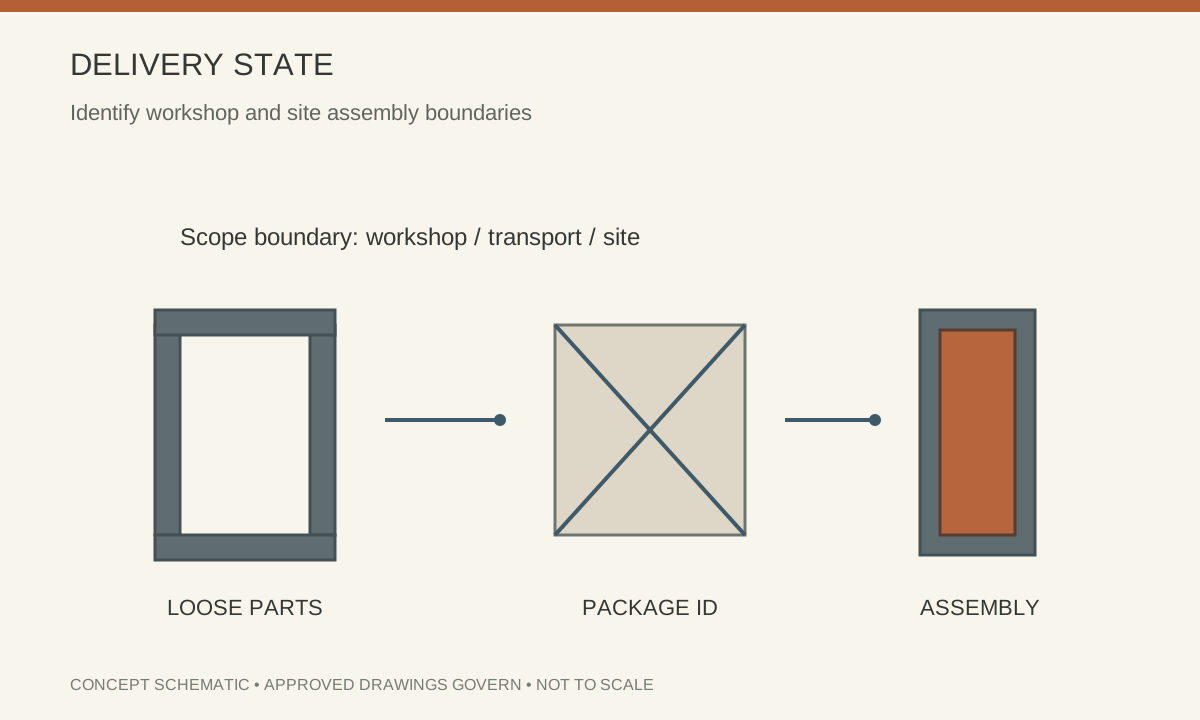
Name the assembly state for every package
Decide whether the supplier delivers loose parts, subassemblies or complete units. Identify the joints completed in the workshop and those left for site work. A picture of a finished planter, frame or screen does not establish what arrives on the truck.
List the interface components: brackets, bolts, backing plates, liners or other project-specific items. State who provides each one and whether it is installed, packed loose or excluded.
Check access before choosing a delivery arrangement
Large completed units may conflict with transport dimensions, unloading equipment or the route into the site. Smaller packages can ease access but create more site assembly and identification work. The project team should compare the complete sequence rather than selecting a delivery state from freight cost alone.
Show connection access and the assembly order. If a joint becomes inaccessible after the next component is fitted, resolve that detail in the approved assembly drawing before parts are packed.
| Checkpoint | Information to agree |
|---|---|
| Workshop scope | Loose parts, subassemblies or complete units |
| Site scope | Remaining joints, tools, access and responsible party |
| Fit-up evidence | Trial assembly or dimensional report if specified |
| Packing | Part/package relationship and hardware identification |
Agree the evidence needed for site fit-up
A trial fit, first assembly or dimensional record can be requested for selected interfaces. Define the extent and acceptance purpose; do not assume every quotation includes a complete shop assembly. Record any match marks that must remain visible after finishing.
At dispatch, organise a packing list that identifies package contents, part marks and installation zones. State how hardware and instructions are supplied. Any transport protection should be compatible with the agreed finish and the planned storage period.
Before releasing the order
- Define delivered condition by assembly mark.
- List included and excluded accessories.
- Coordinate transport and site access.
- Agree fit-up records and package identification.
A clear delivery-state schedule connects fabrication, freight and installation in one purchase scope.
Review the related product inquiry with the approved drawing and material schedule.
NSBA / AISC guidance on constructability and fabrication ↗
General reference for the discussion; the applicable material standard, approved project design and purchase documents govern the order.